
What’s a scan chain really?
Everyone talks about scan chains, but not all truly get what they are.
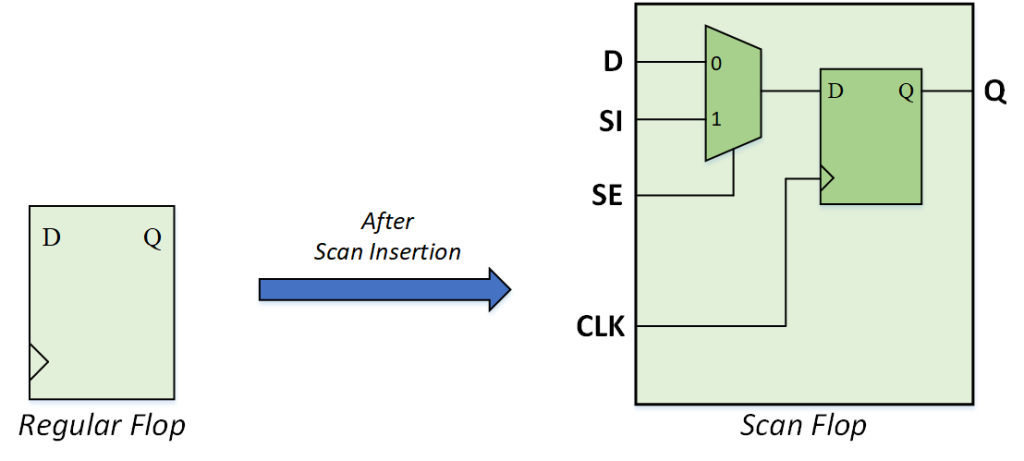
A scan chain is just a sequence of flip-flops connected together, each equipped with a multiplexer (MUX) to select between normal functional data and scan data.
Single Scan Flop

Two Modes, Two Behaviors
1. Normal Mode:
- The MUX selects the functional input (from RTL logic).
- The flip-flop behaves like any regular register in the design.
2. Scan (Test) Mode:
- The MUX selects scan input (usually from the previous flip-flop).
- Data is shifted serially, one bit per clock.
We control this through a scan_enable signal
-> Shift Operation: SE=1, SI to SO:

->Capture Operation: SE=0, DI to DO:

Testing process:
This scan path allows test engineers to control and observe the internal state of the design without needing direct access to internal nodes. The test process involves
· Shift in test vector via scan_in
· Apply one clock pulse to capture circuit behavior
· Shift out results to scan_out
· Compare output to the expected response
This enables fault detection deep inside the circuit using a limited number of I/O pins.
This above figures show 4 scan flip-flops connected serially via SI-SO

Why Multiple chains?
Imagine a chip with 100K flipflops. Shifting them all serially through a single scan chain would take forever. That’s why we split them into multiple chains in parallel say 8, 16, or even 64 chains.
More chains = faster shift, but also higher power and more routing complexity. That’s where scan compression tools come in.
Why balance them?
If one scan chain has 10 flip-flops and another has 1000, the longer one will dominate shift time and likely violate timing. Always balance chains when partitioning scan.
In design debug and bring-up scenarios, scan chains are very much indispensable. They provide observability, especially during early silicon validation or failure analysis. For example, a failure pattern on silicon can be localized by examining the scan out responses and tracing back through the design’s internal state captured in the scan chain.
While scan chains may appear simple in structure, their impact on test efficiency, coverage, and silicon debug is vital. A well-architected scan infrastructure lays the foundation for all higher level DFT strategies, including compression, logic BIST, and at speed test.